Starting out
At 18, I was eager to start my university studies in public health. A lot was riding on this for me coming from a very low-income single-parent household and I felt proud of myself in getting this far.
I’m Lucy, now almost thirty, and if you would’ve told me how my life panned out when I was back at 18, I wouldn’t have believed a word of it.
I seem to be one of those people who is always ‘going through something’ and I rarely catch a break. From a young age, I had way too firm of an understanding of money, debt, benefits and housing. I had to grow up quite quickly.
Having already felt like I had handled so many of life’s challenges before even finding my way out of my teenage years, I thought university would be straightforward.
Plot twist
I attended my university placement on a Tuesday. I had a new teacher who I would be shadowing for the day. He was a Connective Tissue Specialist and I was really looking forward to learning from him. As we moved throughout the day, he casually asked me if I ever experienced fatigue after placement when seeing how I leant against a wall as we stopped to take a break, which I always did. He then asked me a series of questions that have now changed my life forever.
It was on that Tuesday that this specialist, through those questions, felt on the spot that I had a serious Connective Tissue disability. This was confirmed through a series of tests, and I learnt that my treatment options were quite poor now as 19 years of my life had gone by with no-one noticing, and therefore no treatment in place. I was diagnosed with a chronic disability at 19.
In the teachers words, my Connective Tissue disorder was ‘incompatible’ with the university course I had worked so hard to get onto and so now the career, income and life I had all planned out in my head fell apart.
Impact
I was devastated. I dropped out of university and felt like a failure. My student finance stopped; I suddenly had no money. My housing situation got really shaky. It was undoubtedly the worst year of my life. My partner at the time left me, so everything that used to exist in my life honestly disappeared.
Next steps
I remember my dad always use to say that some situations you may find yourself in are not ‘fluffy’. They don’t have a very nice way to go about them, it doesn’t feel very smooth, or easy, and it’s definitely not fun. This was one of those situations.
I needed to zoom out a bit and realise my whole life trajectory had changed, and that this had been a long build up, so I realised this might take a long time to navigate too and that I needed to take care.
I always prided myself on being a good friend to those around me, and I became aware that I needed to be my own friend and get myself back to base, however that might look for me now.
Taking care
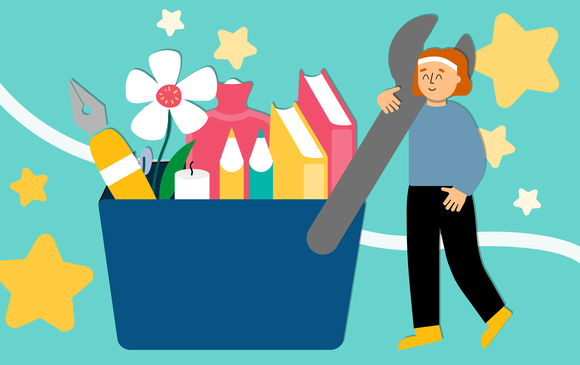
Throughout this time, I created myself a kind of toolkit of things that I knew that even for 1 minute (hopefully longer) could soothe me in some way, even when my circumstances were still the same.
It was important for me to not pretend my problems had gone, or overly try to escape from them as that made it all the harder when I had to return to them.
A few things that supported me during this time
- Counselling (The Mix’s in particular)
- Online emotional support forums (The Mix’s in particular)
- Aromatherapy (putting lots of oil on my hands and taking big breaths in and out)
- Weighted blankets
- Baths
- Meditation
- Meeting my basic needs where possible with dentist visits for example
- Changing out of pyjamas when I’d stayed in them all day
- Having a shower
- Making artwork even if it was basic, with no intention
- Talking to people that cared about me
- Always checking in on my capacity, not over-exerting myself if I could avoid it
- Accessing proper specialist support for complex issues such as accessing benefits, supporting with debt, supporting with housing
- Trying to do one thing at once, eating with no phone/tv, being outside without headphones
- Finding free or low-cost events to keep me busy
- Talking to myself nicely, like as a good friend
- Naming to myself that things were tough, not trying to rose-tint the situation, recognising my resilience to keep on facing each day
To now
Bit by bit, things gradually came together. My dad reminded me that without getting back to myself, and getting the basics down: eating, drinking, sleeping ~ that I would find it hard to do the more complex things: working, studying, socialising. Without my basics, I had no foundation, I really had no choice but to carve out that time for myself and it’s important to not judge yourself when you have to take some steps back.
Through specialist support, I stabilised my finances, and through that, stabilised my housing. I re-joined the world of work, but took my time finding an employer that would understand me and my disability, and working within a role that would give me as much purpose, as close to what I originally wanted to do as part of my plan after university.
I lost some friends during this time, but those who stayed are amazing. I found a new partner, and feel very loved.
I am not saying this is all fixed, my disability will never go. In hindsight, I realised if I would’ve stayed on that course, I would’ve made my disability worse. That’s a silver lining in all of this for me that I can see now, although in the moment there was no way I could’ve felt that way about it at all.
My ability to adapt I feel will remain though, and I will always be willing to carry my toolkit, to get this out whenever a new change or life event may come.
Published