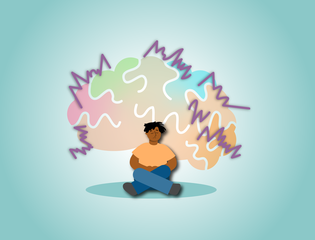
Even at the best of times, everyday sounds can be overwhelming - enough for us to wish we were sinking into a sofa, headphones in tow, retreating into a world of our own.
For some people, the click of a ballpoint pen or thud of footsteps might be a minor annoyance. However, for people with misophonia, it means much more. Hearing normal sounds such as coughing, sniffing and breathing produces intense discomfort, disgust, irritation and anger.
Misokinesia works in a similar way, except that it revolves around sight instead. Seeing someone shake their leg up and down, or pick at their fingernails - these repetitive movements cause discomfort as well as rage. Compared to normal reactions such as annoyance, people with misophonia and misokinesia experience stress that massively disrupts their daily lives.
Although misophonia and misokinesia aren’t recognised conditions, nor can they be diagnosed, their impact remains. Both conditions often coincide with each other, but they can occur separately.
Misophonia
A tightening chest, raging thoughts, a room pressing in closer with every breath. While the reaction depends on the person, the origin remains the same.
Common triggers include:
- Breathing, sniffing or coughing.
- Clicking from pens, mouses, cutlery or the clatter of a keyboard.
- Listening to people eat, particularly loud foods such as crisps or chewing gum.
While anger often shows through clenched fists and gritted teeth, physical responses to triggers extend to a racing heart, becoming restless, getting warm and growing tense.
Our emotions often turn us into people we hate, strangers to ourselves. Waiting for the sounds to start, you might feel as if you’re sat on the edge of a swing, wrapping the chains around your hand, waiting for the moment your grip fails and you fly onto the concrete.
When you’re coping well with most parts of life, you might find that your negative reactions to triggers become easier to manage. Stress, on the other hand, brings a barrage of emotions with it.
Management
What can help:
- Wearing noise cancelling headphones. Even if it only blocks out the noise a little bit, having a way to distract yourself will make your emotions more stable and help you feel in control. Some people find that over-ear headphones help for noise cancelling, while others prefer the comfort of earbuds. Knowing that you have the option to use headphones can help you feel calmer .
- Asking for accommodations. Most workplaces will be willing to let you listen to music while you work, or sit at a desk in the corner, if it helps your productivity.
- If you take the bus to work or school, try to set off earlier. Avoiding peak times, whenever possible, lowers the coughs, sniffs and sneezes that you’ll encounter. You’ll have the option to sit at the front or back, distanced from it all.
- Having another condition, mental or physical, only worsens the situation. Deal with your problems one at a time. Start with whatever feels manageable, even if that means placing them on the backburn for a while.
In an environment outside of your control, your anxiety can only grow. During the more stressful times of your life, ones which no amount of dreaming will force to fade, your sensitivity to sound will increase. Try to find a space that can be yours alone, or something to help you forget your problems, if only for an hour or two.
Misokinesia
Many of misokinesia’s triggers stem from seeing repetitive movements, even just in the corner of your eye.
These include:
- Typing on a laptop or writing by hand.
- Eating, especially if done in an exaggerated or messy way. If someone eats with their mouth open or licks their fingers, it makes the sight harder to ignore, but also creates more discomfort than if they took more care.
- Biting or picking at fingernails.
Even if you place yourself at the front of the room, or turn away from a stranger coughing in a queue, it can be difficult to remain composed. Knowing how you want to react doesn’t mean that you can follow it through. These reactions, whether it’s snapping at strangers, turning to face a wall or leaving the room entirely, happen on instinct.
Instead of always avoiding your triggers, try to find ways of coping with them.
To start with:
- When you don’t have the option to leave, try to move somewhere that makes your emotions more manageable. Even if you worry what people will think, it’s better to prioritize your wellbeing. Move your chair in a different direction, or lift your hand to the side of your face, if only to lessen the anchor settling in your chest.
- Be honest with the people around you. While they might not experience it themselves, many people would be willing to do what they can to help, such as swapping seats, giving you space when everything becomes too much, or listening to your problems without judgement.
- Keep in mind that some places might always be overwhelming for you. While your ability to cope with triggers will change depending on stress, tiredness and many other factors, that doesn’t mean that the problem will go away. Libraries might always be a place of stress for you, and restaurants an experience you could do without. Learn to work within your limits – find a quieter restaurant, one without its tables crumpled together, or avoid visiting the library at peak times.
Asking for support
Misophonia needs to be understood before people can start to move forward. Unless someone experiences it themselves, empathy and sympathy can be hard to feel.
If you want to support a friend, family member or coworker with misophonia or misokinesia, start by being kind. Don’t tiptoe around them, or wait until they leave the room to eat. Just listen to their experiences, asking about ways you can help without blaming them. People interpret silence in different ways; one person’s total silence means dozens of sounds that even rock music can’t drown out to someone else.
Only by opening up, be it to a childhood friend or a stranger in a cafe, can things get better. You might find that talking to a near-stranger makes your words flow with ease, while at the thought of opening up to your parents, excuses fall free. Whoever you talk to, try to be honest with yourself and those around you. Talking about the problem won’t make it go away, but it will be cathartic.
Often, we worry about disappointing the people we care about. Even so, it’s not your responsibility to make your family happy by lying to them. Locking your problems away just makes them harder to deal with. Even with honesty and understanding, the impact of misophonia and misokinesia won’t disappear so easily.
Published